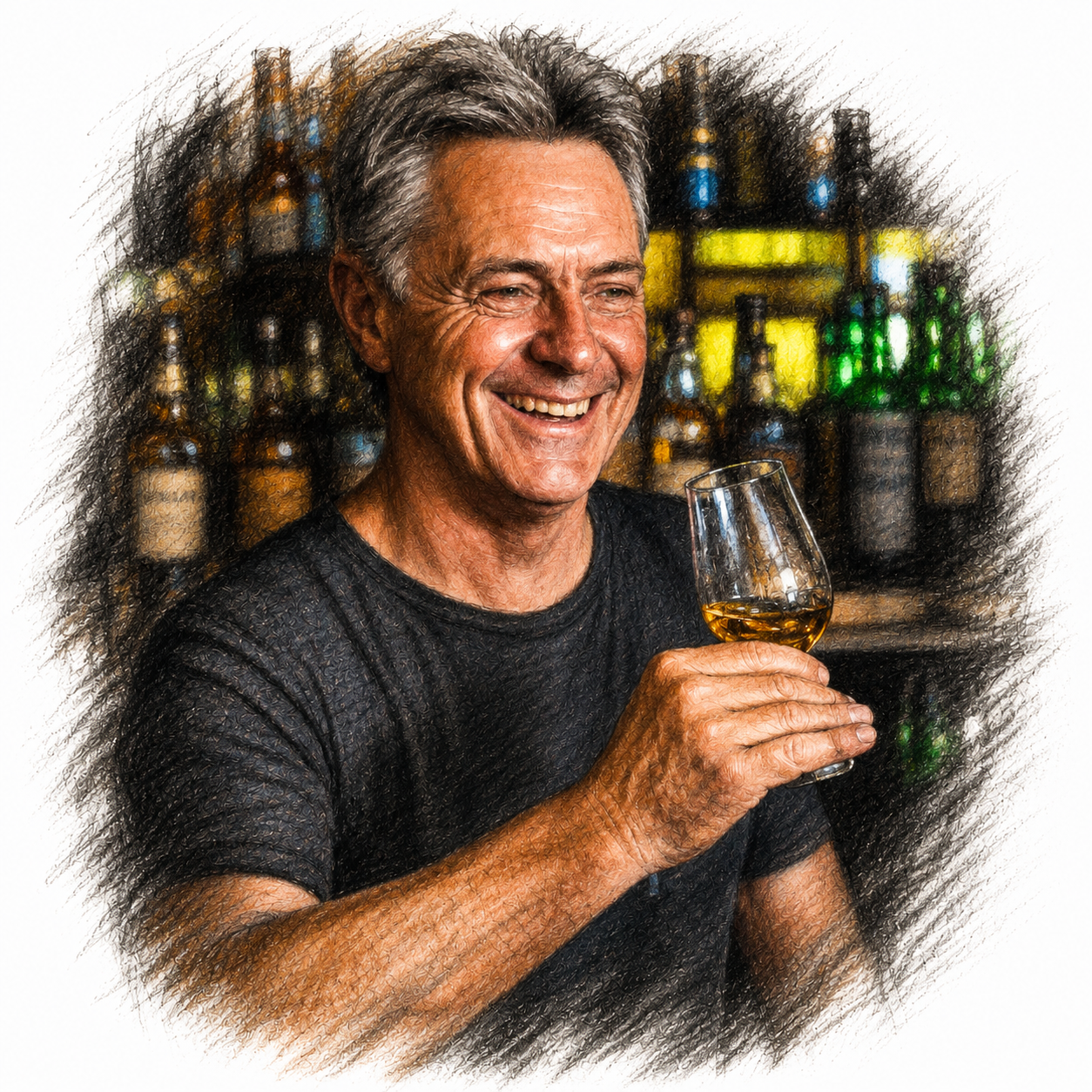
If you know South African whisky at all, you know Dullstroom, and if you know Dullstroom, you know Wild About Whisky. What started in 2005 as a wine bar in Auldstone House has become one of the country’s true whisky destinations — a place where, on a good Saturday, a group might sit down for two hours and not want to leave for six.
David Gunns co-founded Wild About Whisky with his former wife Eve Gunn, and their friend Steve Adams, almost by accident. Nobody in South Africa was talking about whisky tasting in 2006. Nobody knew if anyone would walk through the door. Twenty years on, Dave’s own son and daughter, Sean and Saralee, are bringing a second business — The Whisky Rebellion — into the fold, and the “taste before you buy” philosophy Dave and his partners stumbled into has become the thing people drive from Johannesburg for.
This conversation is about where it all began: the friend leaving for Canada who handed Dave his first proper whisky, the trip to Scotland that planted the idea, the town that turned out to be a perfect fit, and the education-first philosophy that Dave still considers non-negotiable. Sean’s own conversation — about succession, change, and where the business goes next — will follow as a companion piece.
(If you’re interested, I catalogued my first visit to Wild About Whisky, way back in 2014 — Wild About Whisky – A Whisky Lover’s Paradise — and everything I said there, still rings true today.)
The Person
Let’s start at the beginning. What’s the first whisky you can genuinely remember—not necessarily the best one, but the one that made you stop and think, “There’s something interesting here?”
It was in this country, probably my late twenties — I’ve never quite pinned down the exact year. A very good friend of mine was emigrating to Canada, and just before he left I went through to say goodbye. He handed me a bottle of Laphroaig 10 year-old (pre-Royal Warrant).
“What the f##k is this?!”
My only real exposure to whisky before that had been in a previous life in Rhodesia, where because of sanctions the only whiskies you could get your hands on were things like Teacher’s, Bell’s and J&B. That’s what we took to parties, because wine simply wasn’t a thing back then.
Then this bottle turns up, and nobody says a word to me about whisky or the industry, and it stops me in my tracks. You can bleep this out, but my honest reaction was, “What the f##k is this?!” It didn’t resemble any spirit I’d had before. That’s forty-five-odd years ago now, and it has always resonated with me — so that walking into this industry twenty-two or twenty-three years later felt like coming full circle.
Has your own palate changed over the years? Is there a style of whisky you dismissed early on that you’ve since fallen in love with—or one you’ve drifted away from?
It’s not really a single moment — it’s an ongoing thing. Your palate keeps developing, especially in this business, where every week you’re exposed to new styles, new wine casks, completely different flavour profiles.
I’ve always loved peat, but that’s developed into a real love of wine-cask influence — Spanish Rioja casks, and even more excitingly, Cape wine barrels now being used over in Scotland. And I’ve fallen hard for mizunara. It’s extraordinary when you find a whisky with that influence — how much sweeter, how much spicier those notes become. It’s rare, so we chase it whenever we can.
Some years ago Sean and I got involved as judges on the Investec Trophy Spirits Show, and that blind-tasting environment made both of us far more discerning about other people’s whiskies — and about our own palates. You become more curious about why a whisky smells and tastes the way it does. That’s had a huge influence on us, and it’s pushed both of us further into spirits generally — not just whisky.
If we opened your home whisky cabinet tonight, what would surprise us?
I love this question, because I’m in the strange position of leaving a bar full of options every evening and still having to choose what to bring home. If you opened my cabinet, you’d find Rhino Whisky — an everyday drinking whisky we push hard at work because it’s genuinely exceptional value, whether I’m pouring it in the evening or over my oats in the morning. And if I need a bit of that maritime peat, Rock Island is what I reach for instead.
What might surprise you more is that I’m actually a beer drinker at home. I’ve always loved craft beer, and because I’m in the industry, I drink very little generally. I’ll have a beer, and maybe gravitate to a brandy, a cognac or a whisky afterwards. I think that’s what makes me a bit more discerning — because I don’t drink much, when I do, I try to get the most out of it.
What’s one whisky opinion you hold that most enthusiasts would disagree with?
I hate the word “connoisseur.” Guests come to the bar and say, “I’ve got a mate who’s a connoisseur,” and in their minds that usually means Jack Daniel’s and Johnnie Walker — nothing against those, but that person hasn’t had the exposure we have in this industry.
“As long as you’re drinking whisky, it doesn’t matter how you’re drinking it.”
Enthusiasts tend to be quite dogmatic about how whisky should be drunk. I’ve always believed in drinking it however you like — neat, with a few drops of water, with ice, with a mixer. Nearly every distillery in Scotland, and here, will tell you the same thing: as long as you’re drinking whisky, it doesn’t matter how you’re drinking it. The purists will look at you sideways when you say that, but within fifteen or twenty minutes of actually showing someone how to get the most out of a dram, the light bulb goes on and they get it. You see the same thing with cask strength — people insisting it has to be drunk exactly as bottled, when the bottling strength was a business decision, not a moral one.
Outside of whisky, what hobby or interest has unexpectedly influenced the way you think about whisky?
Mountain biking — nearly thirty years now, and I still ride competitively. Honestly, I don’t think it influences the way I think about whisky at all, unless I fall off my bike and decide I need a dram afterwards.
I think that’s actually important. I see whisky and mountain biking as two very different spheres of my life that don’t really connect, and I like it that way. Otherwise you get too bound up in your own little universe. It’s good to think expansively during the day and not be constantly circling back to whisky, beer, spirits — whatever your work is.
When Wild About Whisky began, did you have any idea that you were helping create something that would eventually become a destination in its own right — or did that only become apparent much later?
Honestly, we had no idea whether anybody would even come into our bar. We put a sign out at the start of 2006 saying “whisky tasting.” We had four tasting mats at that stage, and a couple of hundred bottles of wine left over from the previous business. In a slightly skewed, entrepreneurial way, we thought: well, if nobody comes, at least we’ve got a lot of alcohol to get through ourselves.
“We stepped into an abyss, and we had no idea what kind of response we would get at all.“
Nobody in South Africa was talking about whisky tasting in 2006. People understood wine tasting in the Cape, maybe brandy to a lesser extent — but whisky was something genuinely new. We stepped into an abyss with no idea what kind of response we’d get.
The Beginning — Wild About Whisky
Take us back to the beginning. How did the idea for Wild About Whisky first come about?
It started from a brick-and-mortar decision more than a whisky one. Eve and I had brought a manufacturing business through from a dairy farm we’d owned, and Steve and Les Adams had a business of their own, Dullstroom Reservations, which they’d started around 1997. As two couples, we wanted to build a standalone building — Auldstone House — where we could have like-minded tenants, and it went up in 2004.
The actual whisky idea began with Steve and Eve on a trip to the UK in the middle of 2005. They went to Scotland, visited a handful of distilleries, and Steve came back thinking: we’ve got tenant rooms we haven’t really thought about using properly — what if we did whisky tastings? Whenever you visited a distillery like Glenfiddich, which we’ve always loved for the way they still run it as a family institution rather than a corporation, you’d only ever taste that distillery’s own range. There was never anywhere — even in most whisky bars in Scotland at that point — where you could taste different whiskies head-to-head.
Back home, one of our rooms had been leased to a couple from Pretoria running a wine bar and art gallery. They dropped a bombshell on us — the husband had been headhunted by Microsoft to Sydney — and they emigrated, leaving us the bar and all their wine. So we had a decision to make: bring in new tenants, or do something ourselves. That was exactly when Steve and Eve came back from Scotland with a handful of whiskies and an idea. We had all this wine and a room going spare — let’s pour a few whiskies instead.
The name actually came from Eve’s manufacturing business, Wild and Woolly, which she’d run on the farm for years. When we were talking about what to call this new thing, she said, why not Wild About Whisky instead of Wild and Woolly? And that was it.
You started Wild About Whisky alongside Steve Adams, and Eve Gunns. What did each of you bring to the original idea, and what were you hoping to create together?
My first trip to Scotland was in 2009, and that’s really where I began to understand the passion the Scots have for their industry — the people working in the distilleries themselves. It was extraordinary, and we didn’t want to simply copy it, we wanted to share that passion and the education we’d picked up along the way. That became part of how we hosted tastings from the very start, and it hasn’t really changed since — only our own knowledge, and our staff’s, has grown.
Steve, Eve and I ran the bar, and the idea of retail was my contribution to the development of the business — something I’d always wanted to do. I liked the idea of servicing the bar side: if a couple or a group enjoyed something in a tasting, we had it right next door in retail. That’s retail therapy, in a sense, and today we genuinely can’t imagine the business without it.
Why Dullstroom?
It’s a question we get asked in the bar all the time, and it’s a bit like a hand slipping into a glove. After a number of trips to Scotland, we realised this area is remarkably like the Highlands. There’s an old trout fishing community here — arguably one of the original ones in the country — and that’s akin to salmon and trout fishing traditions in Scotland.
Even Auldstone House, our building, has a Scottish echo to it — we found the name on an old wine-estate map from the Hunter Valley in Australia, and when we looked it up, it turned out to be a Scottish place name too. Everything kept pointing us toward Scotland. And there’s a very practical piece too: we’re in a mist belt, over 2,000 metres, so our temperatures aren’t wildly different from Scotland’s at certain times of year, especially with the mist rolling in. It all tied together into a business built on Scottish tradition and custom.
In the early days, what did Wild About Whisky actually look like compared with what people see today?
Just the one room with a bar, and this gorgeous filigree iron wine holder full of bottles we were slowly working through and replacing with whisky. As we grew, we needed more space — at one point we were importing from eight different distilleries in Scotland, and you need somewhere to actually present that many whiskies properly. That’s how the coffee station, and then the next room, came about.
Interestingly, our high season used to be winter and our low season summer, which always surprises people. That’s changed completely — we’re now a fifty-two-weekend destination, and even our weekdays are busy during school holidays.
We eventually turned one room into a second bar — Steve, who’s a carpenter by hobby, built most of the shelving and the bar itself — and a third room became a dedicated tasting room, with whiskies on shelves behind glass that doubled as decor and as a kind of collectible display. Later, we brought retail into that same space properly, which is really the true birth of the retail side of the business, alongside going online — we’ve been online for close to fifteen years now, purely as a service to the rest of the business, never really as a way to make quick money.
Some of it grew directly out of watching families arrive — seven or eight people, partners, a few older kids, only one or two of whom actually drank whisky. We had to think about how to keep everyone there, which is how we developed tequila options, brandy options, chocolate-and-whisky pairings, snack platters — so if people got hungry, they didn’t wander off to find lunch elsewhere. Everything that goes onto our retail shelves gets tasted, not just by Sean, Eve and me, but by every member of staff, so they can speak to the public with real confidence.
Was there a particular moment when you realised that Wild About Whisky was becoming something more than simply a place that served and sold whisky?
It’s hard to point to one single moment. I think we created a kind of symbiosis between the tasting experience and retail, and the reaction from the public told us the sky was the limit. There’s something like an electrical charge when someone does a tasting, finds “their” bottle, and walks out with a smile, carrying something they’ll remember and hopefully come back for. That built up over time rather than arriving in one flash, but that’s when we knew the symbiosis was working — and working well.
From the beginning, education seems to have been central to what you were trying to do. Why was that so important to you?
Travelling to Scotland was life-changing for us, and we wanted to pass that on — not just to the public, but to our staff. Pre-COVID we’d take a couple of staff members on trips to Scotland, and it completely blew their minds. You could see it in how they hosted tastings afterwards.
We eventually took the whole team — including kitchen staff who were there to wash glasses and prep garnishes — down to the James Sedgwick Distillery in Wellington, which we regard as a globally award-winning operation, thanks to a long association with their now ex-master distiller, Andy Watts. It’s genuinely one of the very few distilleries anywhere in the world that matches the technology and the thinking that went into it, and it was life-changing for our staff to see it. They came back able to talk about mash tuns and cask maturation with real confidence, because they’d actually experienced it. Two of our staff members have gone on to distil their own vodka on a farm nearby — sugar-based, but genuinely very good — purely from the passion this exposed them to.
It’s difficult to keep doing that these days simply because of the cost of getting to Scotland. We still want to get staff to Metanoia in the Klein Karoo, and to Pienaar & Son, whenever we take on new people. The deeper the understanding, the greater the appreciation of what’s actually in the glass — and some things you simply can’t teach, only experience. A staff member dropped a bottle of Belgian beer in our storeroom a couple of weeks ago, and for the rest of that day the whole team wanted to work in there, because it smelled exactly like a mash tun room. It takes something like a broken bottle to remind you how deep that goes.
The whisky flights have become one of the defining features of Wild About Whisky. Where did the idea of letting people taste their way through different whiskies come from?
It goes back to Steve and Eve’s original trip — realising there was nowhere doing proper head-to-head tastings. We started with standard flights of six whiskies, and it’s grown from there. We now offer two blind tastings as well — one category-based across different spirits, one purely whisky with a mystery dram included. When someone cracks the blind tasting, the date of their tasting and name gets cut into a beautiful wooden board that is on display. A “list of legends”. So instead of being intimidating, the blind tasting becomes a fun challenge instead.
The retail side really drove how the tastings developed — whatever came into retail needed to be available to taste next door. That meant the printed menu grew to eighteen or twenty pages, which became unworkable every time we changed a tasting, so we moved to a digital, QR-code menu that we can expand as far as we like. On top of the tastings, Sean’s been developing signature cocktails over the last year or two — built completely left-field, so they only taste like that in our bar — and people are increasingly ordering one before they’ve even opened the tasting menu.
What were you hoping people would learn from the flights that they might not learn from simply buying a bottle and drinking it at home?
We wanted every flight to be as diverse as possible across six whiskies, so people could work out what their own palate actually responds to. We build the mat deliberately from lighter styles — easy-drinking, ex-bourbon — through sherry and into maritime and peated styles, so nobody’s palate gets thrown straight into the deep end.
When someone lands on the whisky they keep thinking about — “this is the one, number three, I can’t stop thinking about it” — that’s success. It means they leave understanding not just that they like something, but why they like it, and what to look for next time.
You’ve watched thousands of people discover whisky here over the years. Is there a customer or tasting experience that has stayed with you?
Honestly, there are too many to recall individually. What’s stayed with me is the pattern — watching hesitant whisky rookies come in and leave converted. It’s mind-blowing, and satisfying beyond belief, to change someone’s perception of whisky, even in a small way. One thing that genuinely surprised us: of the people who taste peated whisky for the first time and have that “oh my god” moment, roughly 70% are women aged eighteen to thirty-five. It tends to be the men who are more hesitant about peat — maybe it reminds them of one too many braais.
The Wild About Whisky Experience
Wild About Whisky is unlike almost any other whisky destination/retailer in South Africa. How would you describe the experience to someone who’s never walked through the door?
“If the group is there for four hours, what an absolute pleasure — because they’re having the best time of their lives, and we’re feeling that.”
I think the menu says it all — nineteen pages, built for someone to sit down and spend an hour, two hours, sometimes six. Unlike a restaurant, table turnover has genuinely never been our motivation. We want people to say, “Okay, we’re ready now, can you bring the bill?” — not to feel rushed. If a group is with us for four hours because they’re having the time of their lives, that bounces back on everyone: the staff, us, management, all of it.
The “taste before you buy” philosophy has become synonymous with Wild About Whisky. Was that always part of the plan, or did it evolve naturally from the way you wanted people to experience whisky?
It certainly didn’t exist as a philosophy at the start — in 2006 we genuinely had no idea where the business was going. It grew naturally once retail developed properly, and once we saw that having a little taste of something in retail — even from a bottle they’d have to buy — helped people say “yes, I really like that,” and take it home.
On a side note — we don’t do beer-and-whisky half-and-half tastings, though I’d never say never. Beer is very much a standard in our bar in its own right, and we’ve built up a close relationship with Hey Joe in Franschhoek, who brew Belgian-style beers — a brewery that was actually uplifted from Belgium and brought out here. It’s a real culture in Scotland, the half-and-half, but it hasn’t really taken hold in South Africa, and honestly it moves a little away from what we’re trying to do on the education side — getting people to taste spirits for what they are, not for what’s on the packaging.
When someone walks in knowing very little about whisky, how do you decide where to begin with them?
It comes back to the flights. If someone’s completely new, the full menu is overwhelming, so we recommend a specific tasting that covers every style within six drams. Often people will say, “I drink Jameson,” or “I had a Glenfiddich once, that’s my taste” — and we’ll ask, but have you had a sherry-style whisky? A peated one? That’s the only way they’ll actually find out.
We don’t push the easiest, safest option either — a Jameson or a Toki — because we want people to experience the medium and the heavy styles too, in a safe environment, with us there to guide them. You’ve got to let them build that experience themselves, with as little influence from us as possible beyond helping them navigate the menu.
With such an extraordinary whisky collection, how do you decide which bottles go behind the bar, which stay on the shelves, and which are simply too special to pour?
“If you can afford it, buy two — you don’t want to die not knowing what it tastes like.”
There are very few exceptions — at the moment, maybe one bottle in retail. Everything else, even things regarded as collectible, is available in the bar for tasting. We’re not really a collectible arena; that’s not our thing. If someone wants to buy a bottle purely to keep, we’ll tell them: if you can afford it, buy two, because you don’t want to die never knowing what it tastes like. Every whisky that’s been bottled is meant to be drunk, no matter what it costs — it’s just become a commodity for some people, and that’s a reality of the industry we can’t change, even if it means we’ll rarely get to taste those bottles ourselves.
Looking around the bar today, is there one bottle that perfectly captures the spirit of Wild About Whisky?
It’s a tough one — I could name plenty. But there’s one that has everything I think an incredible whisky should have: Ledaig 18 Year Old. It’s a marriage of ex-bourbon, Oloroso sherry, maritime complexity and plenty of peat! If I had to single one out, that would be it.
If somebody told you they only had two hours at Wild About Whisky, how would you tell them to spend it?
In a nutshell: come in, select a hosted tasting — that interactive experience is the most important part — and then go and find the bottles that blew you away. That’s two hours well spent.
The Business — And What Comes Next
Wild About Whisky is now a family business. How did your son and daughter become involved, and how has having the next generation working alongside you changed the business?
Sean actually started out as a sound engineer. One of his closest friends from that world loved whisky as much as he did, and in 2015 — nine years into Wild About Whisky — the two of them started The Whisky Rebellion, doing bespoke flights without a fixed venue, hosting tastings at corporate events, people’s homes, or wherever they were needed.
Saralee came in around the same time, doing admin for Sean as the business grew — she trained as a journalist, and there was enough demand pre-COVID that she needed to keep the back end running. Everything changed in June 2022: Sean moved from Johannesburg to Dullstroom to fully integrate into Wild About Whisky, while, at the same time, still helping Saralee operate The Whisky Rebellion in Johannesburg. And that same July, Eve and I took Saralee to Scotland. Over two and a half weeks we did something like twenty-six distilleries. The idea was to plug her completely into the industry, and it worked — one image I still have is of her tasting new-make spirit straight from the spirit safe at Ardbeg, where the team had just opened newly built stills. By the end of the trip she knew this was what she wanted to do, and when we got back she took over the planning and hosting side of The Whisky Rebellion with her own team.
“I’m immensely proud of both of them — what they’ve achieved on their own, with hopefully as little influence as possible from my side.”
Eve is still involved in the back end — banking, tax — though she’s stepped back from hosting, and still pops in on Saturdays to help with groups. The plan for both of us is to gradually step back and let Sean and Saralee carry both businesses forward. Within five years, I’d like to see the two of them here in Dullstroom running The Whisky Rebellion and Wild About Whisky as one integrated business.
As the business evolves, what parts of the original Wild About Whisky philosophy are non-negotiable for you?
Education, first and foremost — and destroying the myths that this industry is full of. There are so many myths and legends that don’t hold up, and we love showing people that. Alongside that, sharing the genuine stories we’ve picked up from the global whisky and spirits world over the years — people love hearing them, and honestly, they’ll often ask us to sit down and tell them, which I’m quite shy about doing, though the staff sometimes will if there’s a connection with a group. Education, storytelling, myth-busting — those are non-negotiable.
Is there anything about the original vision for Wild About Whisky that has changed significantly over the years?
Almost everything, in practical terms — far more stock, a far bigger menu than we ever imagined. What’s genuinely surprised us is the reach. Someone once sent us a menu from a bar in Japan with four or five of our tasting names on it — not that it matters who copies who, but it’s remarkable that people see value in what we’re doing on the other side of the world. Even stranger: a client told us he’d been to the Temple Bar in Dublin, mentioned he was South African, and the bartender there immediately asked if he knew Wild About Whisky. He hadn’t, at the time — but he tracked us down afterwards. It’s sobering, and a little unbelievable, that our reach extends that far through such an indirect route.
When you look at Wild About Whisky today, what makes you proudest?
The moment we see the spark in a customer’s eyes — that realisation of what they’re actually experiencing. And the guests who come back, again and again, and proudly tell the staff they’ve been here before, or that they’re already looking forward to next year.
Tourism has changed enormously since you first opened. How has the role of Wild About Whisky evolved within Dullstroom and the wider tourism industry?
It took years to develop into a genuine destination — for the first several years we were simply one option among many in Dullstroom. As we grew, I think we’ve had a knock-on effect on the town more broadly, bringing in people who might not otherwise have made the trip out here, which benefits accommodation and restaurants too. Businesses in Dullstroom refer to each other constantly — if someone asks a shop owner where to eat or what else to do in town, and they know us, they’ll send people our way. That, I think, is part of the health and vibrancy of Dullstroom today.
Looking ahead, what do you hope Wild About Whisky becomes — but perhaps more importantly, what do you hope it never stops being?
“Within five years, I envisage both of them being here in Dullstroom, running TWR and Wild About Whisky as an integrated business.”
Looking five years ahead, I’d like to see The Whisky Rebellion fully integrated with Wild About Whisky, with Sean and Saralee running both businesses collectively. What it looks like exactly under their tutelage, I honestly don’t know — that will be for their generation to decide, and it should be relevant to whatever’s coming next. But the core philosophy — education, being genuinely customer-centric — that’s never going to change.
The Industry
What’s changed the most in the South African whisky scene over the past decade — and what hasn’t changed enough?
The biggest change is the production and availability of genuinely exceptional South African whiskies — alongside, unfortunately, a counterbalance of fly-by-nights producing things that shouldn’t really be called whisky, which is exactly why education matters. There was a rocky patch when Heineken took over Distell and a lot of the limited-edition whiskies Andy Watts was producing at James Sedgwick simply weren’t available — but that’s turning around, and JSD is re-releasing a lot of that work now. Alongside that you’ve got Pienaar & Son and Metanoia in the Klein Karoo doing exceptional things.
What hasn’t changed enough is the public’s understanding of value-for-money whiskies, and the allure that big-name, profiteering corporate distilleries hold for collectors. That collector mystique needs to move to the backstage — it’s another myth in this industry. People need to understand you can get incredible liquid for R500 to R1,000 without knowing the “right” name.
What’s one trend in whisky that you think is genuinely exciting, and one that you think is mostly hype?
“I’m trying to give people other options to those number one, number two, number three corporate distilleries out there — that are actually losing relevance, big time.”
The exciting trend is that genuinely good value whiskies are flooding onto the market now — you can get a really good dram for R1,000 or less, which reflects distributors realising the collectible side of what they import barely matters in this country, and that people, globally as much as locally, are looking for value. Expensive doesn’t automatically mean good — sometimes it’s simply been sitting in a warehouse not earning money, so it has to cost more when it’s finally released. Cheaper doesn’t mean inferior either. We push that message fairly hard, because it gives people other options to the two or three big corporate distilleries that are, frankly, losing relevance.
Which part of the whisky world isn’t getting the attention it deserves right now?
Cocktails, in a way. There are hugely talented mixologists out there creating extraordinary drinks, but I sometimes wonder if the whisky itself — the actual hero of the drink — is getting lost. Instead of an average whisky in the mix, use something exceptional, so that even in a cocktail, people can genuinely taste that whisky. That’s what drives our own signature cocktails, and I think on-con establishments generally need to put more weight behind the core spirit.
What’s the biggest mistake you see people making when buying — or drinking — whisky?
Attractive packaging hiding very average liquid — we see it constantly, and not just in whisky, in tequila too. And the habit of pouring a mixer or ice straight in without tasting it neat first. It’s important to taste it as bottled first, understand it, and only then add water, ice or a mixer if you want to. Most people just get it poured with the mix already in the glass and never really acknowledge what’s in there.
Is there a bottle, distillery or trend that everyone seems to chase, but you think people should stop obsessing over?
There are a couple of names that keep coming up in conversations with people — classic cases of over-promise, under-deliver, priced ludicrously, and genuinely disconnected from the general whisky-drinking public. There’s a corporate arrogance in parts of this industry, particularly among some of the biggest names, that’s the complete opposite of what Scotch whisky’s ethos has always been about. We’re trying to steer people away from that.
On the flip side, what’s quietly sitting on shelves today that deserves far more attention than it’s getting?
The obvious answer, given what I’ve just said — plenty of whiskies at two or three hundred rand less than the big names, that are just as good, if not better. We’re constantly telling clients: if you like that style, why not try this instead?
Imagine a newcomer arrives at Wild About Whisky with R2,500 to spend. Would you rather see them leave with one remarkable bottle or spend the afternoon tasting ten different whiskies? Why?
Honestly, they don’t have to choose. I’d rather they came in, did a standard head-to-head tasting of six whiskies, and walked out with a healthy R2,000-plus still in their pocket to spend on a remarkable bottle — or even two — in retail. Prices have come down enough over the past couple of years that this is genuinely achievable now, where a couple of years ago that same money might have only stretched to one average bottle.
South African whisky tourism is still relatively young. What do you think it will take for it to become a true international drawcard?
James Sedgwick is already something of an international drawcard for people who love the industry — it shows what a distillery on the African continent can look like. Beyond that, I think the future belongs to people like those behind Pienaar & Son and Metanoia — creators who often started in wine or farming, travelled to understand the process, and came home to build something genuinely inspired. The industry looks a lot rosier than it did five years ago, and post-COVID there’s more optimism generally. Look at what Tasmania has done for Australian whisky — there’s no reason South Africa can’t do something similar, even if we’re not there yet.
What conversation do you hope South African whisky lovers are having five years from now that they aren’t having today?
I’d like to see a wave of new South African micro-distilleries genuinely challenging global producers — and specifically making full use of a wine industry that’s three hundred-plus years old, with all those incredible barrels and the wines that have lived in them, and the influence that could have on South African whisky. We’re already seeing it with James Sedgwick and with Metanoia. I hope in five years the conversation isn’t about what’s being imported, but about what’s being produced and marketed here at a level we can’t quite imagine yet — and that it becomes a genuine second industry for the Cape wine sector, one that can sell barrels not just locally, but globally.
“He (Jim McEwan) put his valinch into it, took it out, dipped his finger in, and drew a cross on each of our foreheads.”
Great and detailed writeup – many thanks for sharing it with us.
Been to WaW many times, but had no inkling as to what all was behind it.
Thank you.