
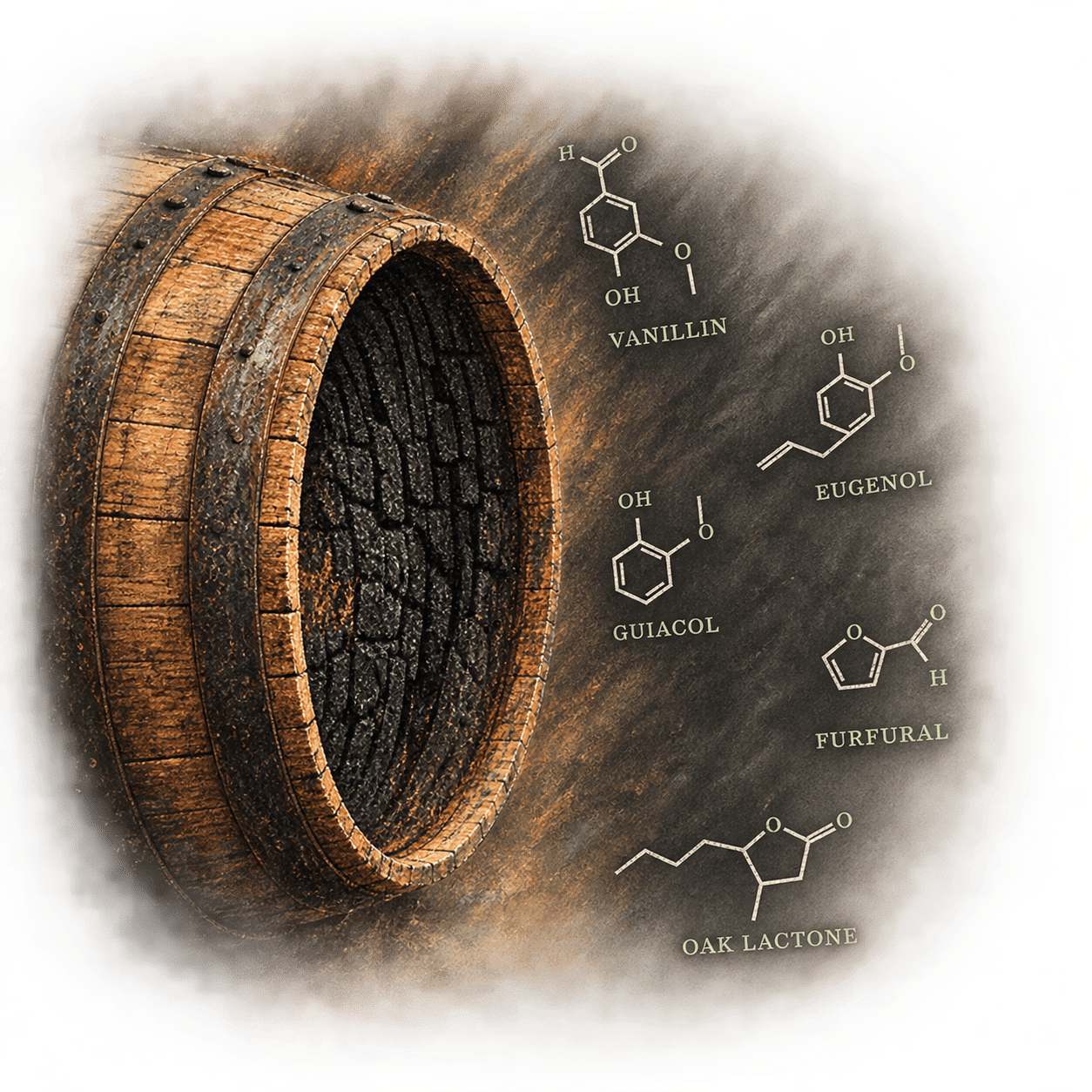
Let’s put on our lab coats and take a look at how wood builds flavour. It’s always interested me, and having a daughter in the house studying chemical engineering means there’s now someone to ask when the explanation stops making sense, which it does fairly early on.
Vanilla is the obvious place to start. It turns up in just about anything bourbon-matured, and the compound behind it is vanillin. There is some vanillin in untreated oak, but not much. Most of what you taste is made when the cooper puts a flame to the inside of the barrel and the heat starts breaking down the lignin.
To see why, you need to know roughly what a tree is made of: most of the structure is cellulose and hemicellulose, both built from chains of sugars, with hemicellulose the weaker and more heat-sensitive of the two. Holding it all together is lignin, a big knotted molecule, and most of the aromatic compounds we care about come out of breaking it apart. On top of those three there’s a scattering of other substances called extractives, which includes the tannins and the compounds behind that coconut note.
With that in mind, picture a cask as raw material, rather than flavour, and it takes heat, spirit and time to turn one into the other. After reading up, it becomes clear that the vanillin is made in the cooperage, an interesting tidbit.
The cooper’s fire
Before any spirit goes near it, the inside of a cask gets heat treated. Toasting is the slow version, working warmth down into the wood. Charring is fast and fierce and leaves a blackened, carbonised layer on the surface, with a zone underneath that has been heated but not burnt.
Two things then fall apart in useful ways. Hemicellulose, the heat-sensitive one, breaks down into a family of compounds called furans, which are behind toasted, nutty, almond-ish character. Lignin breaks down into vanillin, into eugenol, which is the compound that makes cloves taste of cloves, and into guaiacol and its relatives, which bring smoke and ash. Every one of those notes exists because something in the wood was taken apart by heat.
More heat doesn’t mean more flavour, though. Compounds form at one temperature and come apart at another, so a fire pushed too hard destroys the thing it was making. Char also works in the other direction. Its carbon-rich layer can adsorb sulphur compounds out of the spirit, so a heavily charred barrel takes things away as well as giving them, which is part of why it does something quite different to a lightly toasted one.
Coconut, and why it’s mostly an American oak thing
You’ll find a fair number of whiskies with a coconut note to them. It comes from a pair of compounds called oak lactones, or whisky lactones if you prefer, which are really two versions of the same molecule, built from identical atoms assembled in slightly different arrangements. One version smells of coconut and sweet wood, the other leans woody and spicy. My daughter explained why the arrangement matters, which is that smell works by shape and fit, so the two versions don’t fit the same receptors in your nose.
American white oak (Quercus alba) carries more of these lactones than the European oaks (Quercus robur and Q. petraea), and more of the coconut-smelling version in particular, which your nose picks up at very low concentrations. European oak goes the other way and gives up more tannin instead. That’s the chemistry sitting underneath the shorthand we all use, vanilla-and-coconut American oak against drier, spicier European oak. It isn’t a rule, though. Individual trees vary, seasoning the staves outside for a few years changes the numbers before the cask is even built, and a cask that previously held sherry turns up with a whole chemistry of its own layered on top.
The drying finish
We’ve all left a teabag in too long and ended up with a cup that dries your mouth out. That’s tannins at work, and oak has its own, the ellagitannins. They’re large molecules with a habit of sticking to proteins, and saliva is full of proteins whose job is lubrication. Bind those up and the lubrication stops working, which is why the sensation is a feel rather than a taste, and why a whisky can be drying without being bitter. European oak tends to be richer in ellagitannins than American, and a first-fill cask has far more to give than a tired fourth-fill hogshead.
The cheat sheet
| Compound | Comes from | Shows up as |
|---|---|---|
| Vanillin | Lignin, broken down by heat | Vanilla |
| Oak lactones | Oak extractives, more in American oak | Coconut, sweet wood, spice |
| Eugenol | Oak, plus lignin broken down by heat | Clove, warm spice |
| Guaiacol and related phenols | Lignin | Smoke, toast, ash |
| Furans (furfural and relatives) | Hemicellulose, broken down by heat | Toasted, nutty, almond |
| Ellagitannins | Oak tannins, more in European oak | Dry, puckering mouthfeel |
Same warning as the post about the flavour wheel, though. It’s a vocabulary, not a key. Some of these you can pick up at tiny concentrations while others need a lot more before they register at all, several of them land on the same note, and they all shift how you read the ones around them. Finding vanilla doesn’t tell you how much vanillin is in the glass, and coconut won’t tell you which oak the cask was built from.
Extraction is only the first part
Pulling compounds out of the wood is only the opening move. After that you’ve got oxidation, reactions between things already dissolved in the spirit, evaporation through the staves, and whatever the warehouse is doing to all of it. Temperature swings, humidity, cask size and where the cask sits in the racking all change the pace.
Some compounds build up as the wood keeps giving them up (vanillin, the lactones). Others get used up or transformed along the way (the tannins, which oxidise and combine with other things as they go), and the lightest ones simply evaporate off. The balance keeps moving, which is why older doesn’t automatically mean better. Leave a spirit long enough in an active cask and the wood wins, and a whisky that was beautifully balanced at 18 can be all oak and tannin at 30.
It’s not a one-way transfer either. The char pulls sulphury compounds out of the new make at the same time as the oak is giving up its vanillin, and some of what you end up tasting was never in the wood or the spirit to begin with. Oxygen works its way in through the staves and drives slow reactions inside the cask, and over the years alcohol and acids combine into esters, which is where a good deal of the fruit in an older whisky comes from.
The part I keep coming back to is the scale of it. A warehouse is a few thousand casks, none of them stirred, sitting at whatever temperature the weather is doing that week, each one on its own slightly different trajectory, and there’s no way to check on one without opening it and changing it. Vanilla has a compound behind it, coconut points at one oak species over another, a dry finish is tannin getting in the way of your saliva, and all of it carries on in the dark for years with nobody watching.
A few useful scientific reads:
- The Impact of Compounds Extracted from Wood on the Quality of Alcoholic Beverages – a broad review of wood-derived compounds and their sensory associations.
- Factors in Modulating the Potential Aromas of Oak Whisky Barrels: Origin, Toasting, and Charring – how oak origin and cooperage treatment affect the compounds behind aroma.
- Sources of Variation in Bourbon Whiskey Barrels: A Review – barrel construction, heat treatment and the chemistry of bourbon maturation.
- The influence of wood species of casks on matured whisky aroma – a Heriot-Watt thesis comparing American, European and Japanese oak, with a lot of detail on the lactones behind the coconut note.
- An odour detection threshold determination of all four possible stereoisomers of oak lactone – the work behind the claim that one version of the molecule is far easier to smell than the other.
- A review of astringency and the oral mechanisms behind it – tannins, salivary proteins and why the sensation isn’t a taste.