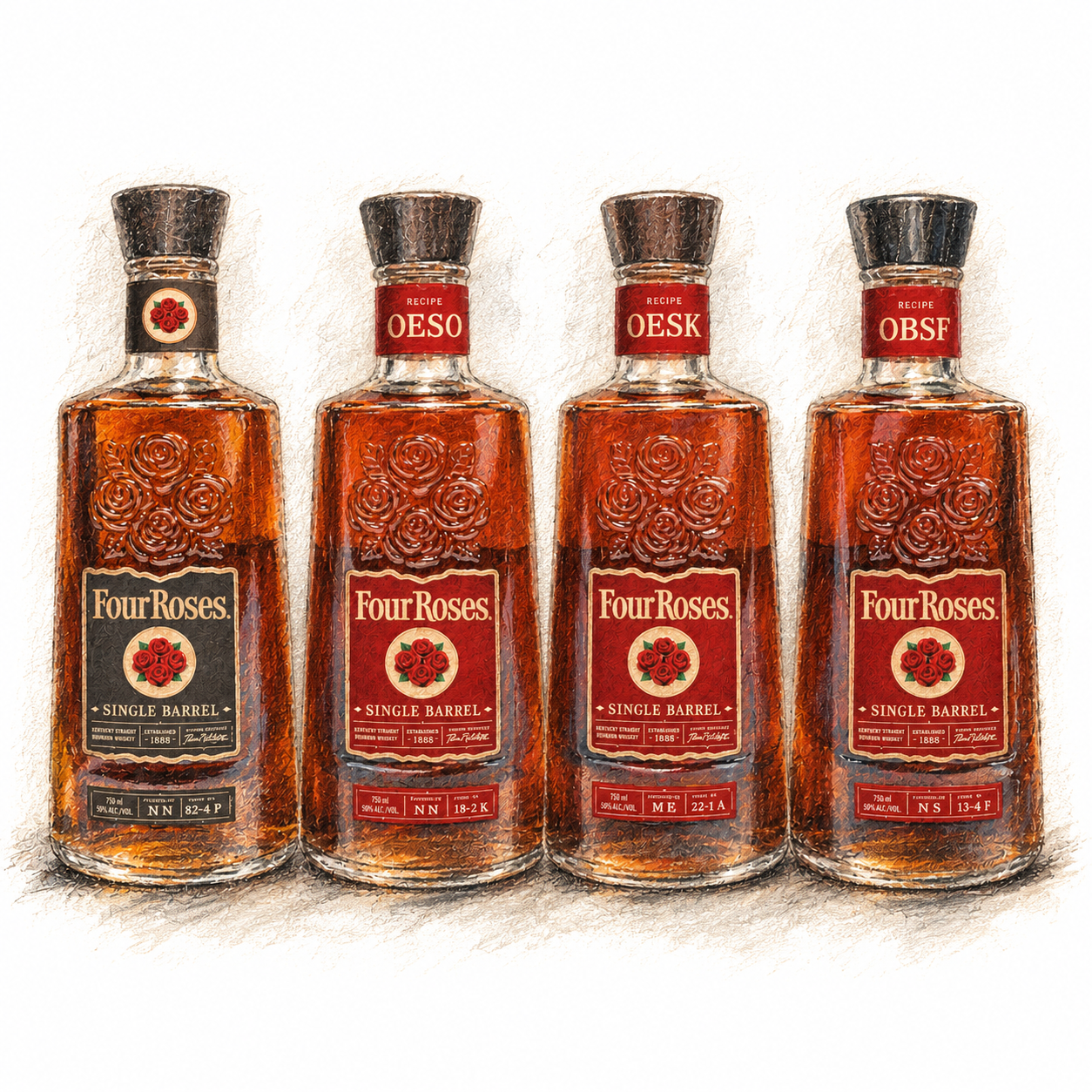
While trawling the local retailers for new releases, I saw four different Four Roses bottles on a site. Three of them had a four-letter code printed on them: OBSF, OESK, OESO, and the fourth had none. My curiosity piqued, I did what any whisky geek would do: bought one of each and then dived into some research.
It turns out that Four Roses runs ten different bourbon recipes out of one distillery, and the code tells you which one is in the bottle. The Four Roses recipe code is broken down as follows:
O – the distillery
B – the mash bill, 60% corn, 35% rye, 5% malted barley
S – straight whiskey
V – the yeast strain, which Four Roses describes as delicate fruit
The S and the O never change. Every Four Roses recipe starts with O and has S in third place, which means only two of the four letters are doing any work.
The O is for Old Prentice
Four Roses’ own material says the O designates the distillery, but why an “O”?
The building on Bonds Mill Road in Lawrenceburg wasn’t always called Four Roses. It was built in 1910 by the Brown family and named the Old Prentice Distillery, after George Prentice, a Louisville newspaper editor they admired. Its Spanish Mission-style architecture is unusual enough for Kentucky that the building is on the National Register of Historic Places.
Four Roses, meanwhile, was a separate brand, trademarked by Paul Jones Jr. in 1888 and made elsewhere. The two came together under Seagram, who bought Frankfort Distilleries and the Four Roses brand in 1943, then the Old Prentice Distillery itself in 1946. The distillery carried the Old Prentice name for another five decades. It only became Four Roses Distillery in 1994.
So the letter at the front of every recipe code is a survival from a name the place stopped using thirty years ago, and nobody has seen any reason to change it.
Ten recipes, not one
Four Roses doesn’t work with a single bourbon recipe. It has two mash bills and five proprietary yeast strains, giving ten combinations.
The B mash bill is the higher-rye one at 60% corn, 35% rye and 5% malted barley. The E mash bill runs 75% corn, 20% rye and 5% malted barley. Both are rye-forward by industry standards; the gap between them is what 15 percentage points of rye does to a bourbon.
The five yeasts are where it gets unusual. Four Roses characterises them as V for delicate fruit, K for slight spice, O for rich fruit, Q for floral essence and F for herbal notes. Most distilleries treat yeast as a fixed input to be standardised out of the equation. Four Roses treats it as a variable.
The four bottles I bought are from Four Roses’ Single Barrel Collection, launched back in early 2025. And the cool thing is that I won’t be tasting these alone, as the bottles are going to be split with fourteen other people, and I’m asking them to submit their tasting notes, but more on that later. are splitting them with me, so I’m clearly not the only one curious. Conveniently, these four make a good introduction to the idea, because you can see both variables at work.
The bottle with no recipe listed is Four Roses’ flagship single barrel recipe, the OBSV, with OBSF, OESK and OESO as the three new recipes.
The four recipes
| Recipe | Mash bill | Yeast | Four Roses’ collection notes |
|---|---|---|---|
| OBSV | 60% corn / 35% rye / 5% malted barley | V – delicate fruit | Rye spice, apricot, pear, cinnamon, toasted oak |
| OBSF | 60% corn / 35% rye / 5% malted barley | F – herbal notes | Herbal notes, bright rye, apple, vanilla, clove, cocoa |
| OESK | 75% corn / 20% rye / 5% malted barley | K – slight spice | Baking spices, mellow oak, tea leaves, caramel |
| OESO | 75% corn / 20% rye / 5% malted barley | O – rich fruit | Rich red fruit, vanilla, brown sugar, delicate oak |
Two of these line up neatly. OBSV and OBSF are both the B mash bill, so the only thing separating them is the yeast – Four Roses call the V recipe delicate fruit and rye, and the F recipe delicate rye and mint. OESK and OESO are both the E mash bill, moving from baking spice to rich fruit and vanilla.
This set was put together to show the diversity, two different mash bills, four different yeast strains, so we’re not going to have an opportunity to pit the mash bills with the same yeast variety against each other. In order to do that, we would need to grab bottles from the Four Roses 2026 Single Barrel Collection, which as OESF, OBSK and OESQ, along with the flagship OBSV. (Note to self: try source these for a comparison!)
Four bottles, four barrels
There’s another layer of information on these bottles that’s easy to overlook.
My four are:
- OBSV – Warehouse NN, Barrel 82-4 P
- OBSF – Warehouse NS, Barrel 13-4 F
- OESK – Warehouse ME, Barrel 22-1 A
- OESO – Warehouse NN, Barrel 18-2 K
The warehouse code is two letters: the first identifies the building, the second the side of it, with N for north, S for south, E for east and so on. So NN is Warehouse N, north side.
The barrel number reads rick, tier, position.
A rick, if you’ve not come across the term, is the wooden framework a bourbon warehouse is built around. Barrels aren’t stacked or shelved – they’re rolled in and laid on their sides across horizontal rails, and each bay of that framework is a rick. Tiers are the levels within it. A Four Roses rick holds somewhere around 22 or 23 barrels across each tier, and it’s where the word rickhouse comes from.
So the number before the dash is the rick, the number after it is the tier, running from 1 at floor level to 6 at the top, and the letter is the barrel’s position along that rick and tier. My OBSV, at 82-4 P, sat on rick 82, tier 4, in position P.
Let’s take a brief look at maturation too. These Single Barrel Collection releases are 100 proof and aged 7-9 years in new charred American oak at Cox’s Creek.
Two things stand out about Four Roses compared to other bourbon distilleries. The first is the warehouses: Four Roses is one of very few major distilleries using single-storey rack warehouses, and it says the temperature varies by about 8°F from the top rack to the bottom, against as much as 30°F in a conventional multi-level rickhouse.
The second is the entry proof. Spirit comes off the doubler (think of it as the spirit still, but slightly different) at around 138 to 140 proof and is watered down to 120 before it goes into the barrel. The legal maximum is 125, and Four Roses deliberately goes in under it, on the basis that different proof levels pull different flavours out of the wood.
So by the time the bourbon reaches the bottle there are several variables in play: the mash bill, the yeast, the entry proof, the individual barrel and where that barrel spent its years. That’s a lot of information to squeeze into four letters and a few numbers on a label.
Pour them side by side
If you have all four, it makes sense to start with the two E recipes and move on to the two B recipes afterwards. The reason being that the B mash bill – with its 35% rye – is likely to be more assertive of the two. It’s the same logic as leaving the peated Islay until after a gentle Speyside – start with the lower-rye mash bill and work up. Whether that expectation plays out when we actually taste the line-up is another story, one that we’ll be reporting back on.
And then when working your way through the bourbons, approach it with two factors in mind: first, see what changes between the yeast strains on the same mash bill, and second, consider what shifts when you move from 20% rye to 35%.
You may not come away with a definitive answer about exactly what each letter contributes. Whisky rarely makes things quite that simple. But you’ll have a much better idea of what those little codes on a Four Roses bottle are actually telling you.
Tasting notes to follow
All the notes above are Four Roses’ own. As mentioned, I haven’t tasted these bourbons yet.
That changes shortly. I’ve finished pouring the split – 60 x 50ml bottles, labelled, and bagged per person, ready to send out to those who signed up. I’ll be adding a QR code that links the taster to this page, so they can read through this info, just as you are. And then, hopefully they will diligently record their tasting notes and send them back to me.
I’ll be adding our tasting notes to this article once we’ve all had a go. If you’re part of the split, send yours through and I’ll include them. And if you just happen to have any of these bottles on your shelf, the invitation is open to you too. I’m always keen to hear what people think about the dram in their glass.
References
- Four Roses, Our Process – mash bills, yeast strains, recipe code breakdown, warehousing temperature variation, barrel entry proof
- Four Roses, Single Barrel OBSV – proof, age range, recipe
- Four Roses, Single Barrel Collection – the 2025 releases
- Four Roses, Through the Decades (1940-1950) – Old Prentice Distillery history, Seagram acquisition, 1994 renaming
- Four Roses, Featured Recipe: OBSV – why OBSV is the Single Barrel recipe
- Bourbon & Banter, First Taste: Four Roses New Single Barrel Collection – distillery tasting notes for all four recipes
- Difford’s Guide, Four Roses Single Barrel – September 2004 launch
- Debonair Gentlemen, How To Read A Four Roses Label – warehouse, rick, tier and position notation
- The Bourbon Culture, Four Roses Single Barrel Review – barrel position lettering and rick capacity