
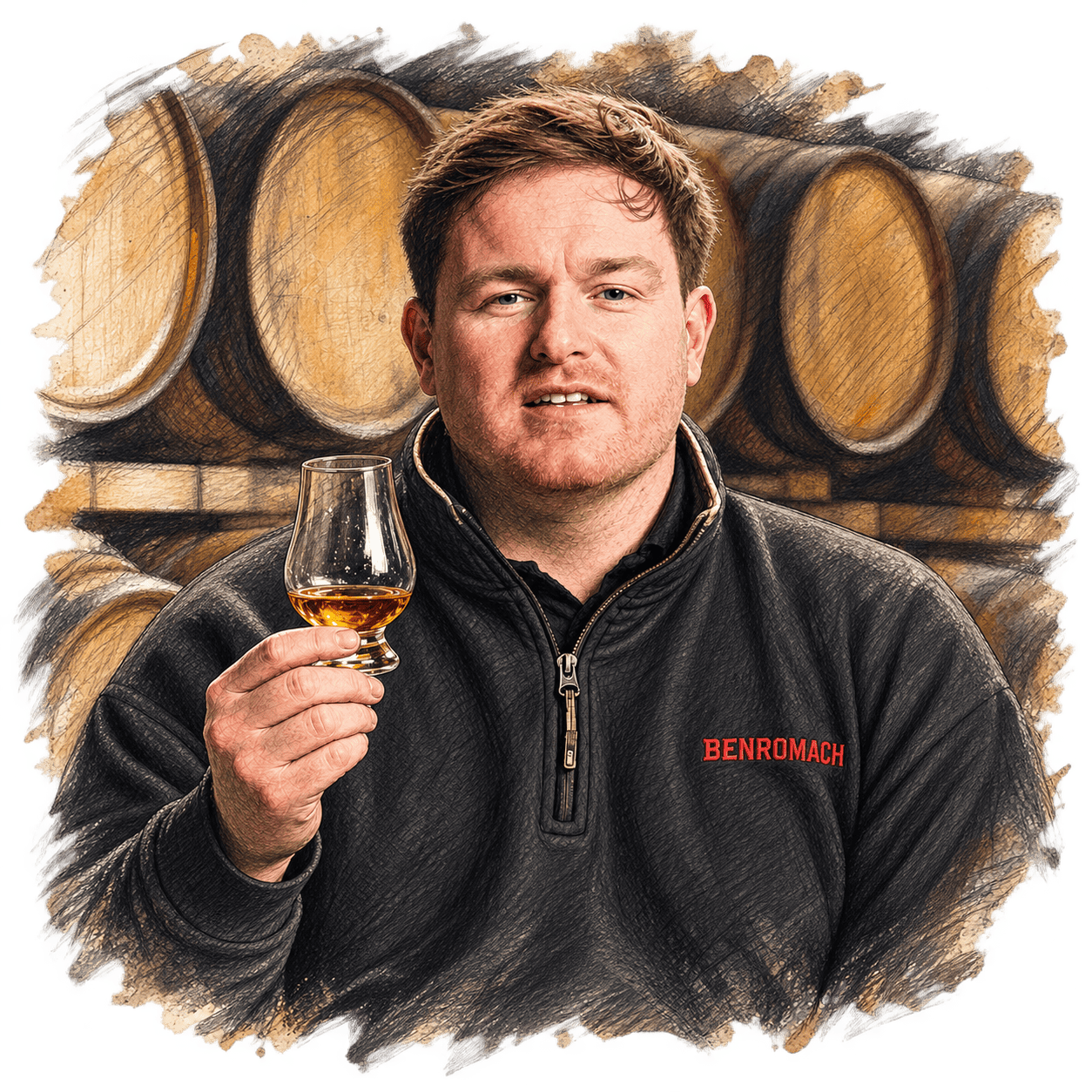
Murdo Mackenzie has been distilling at Benromach since 2016, and in 2025 he took over as Distillery Manager from Keith Cruikshank, who ran the place from 1998. It’s a role that comes with an unusual kind of weight: almost everything he decides today — how the mash is handled, the exact point the stills are cut — won’t reveal itself as the right or wrong call for years, sometimes a decade or more.
He arrived at Benromach after starting out in Gordon & MacPhail’s Elgin warehouse, and by his own account it was a whisky course — taught by a man named Vic Cameron — that properly opened his eyes to what whisky could be. Since then he’s learned the distillery inside out, quite literally, given how much of Benromach’s process is still run by feel, sound and sight rather than by instrumentation.
This conversation covers a heart-in-the-throat first solo shift, the grace of time, and finding the balance between embracing progress and preserving tradition.
The Person
Let’s start at the beginning. What’s the first whisky you can genuinely remember — not necessarily the best one, but the one that made you stop and think, “there’s something interesting here”?
I remember being eighteen, in a local pub round the corner from where I stayed, with some friends from work. Normally I’d just have a lager, but one of the guys said he’d have a dram, and I ended up having an Isle of Skye eight-year-old. That was the first whisky I can say I properly tasted, about seventeen years ago now, and I still remember the burn.
I wouldn’t say I was fully interested then — I think at eighteen you’re still figuring out what you want to do with yourself. But it’s the one I remember. It was on the optic at the bar, they just poured it straight out, and I thought, this is new, let’s see what happens here. And it hit the spot.
Has your own palate changed over the years? Is there a style of whisky you dismissed early on that you’ve since fallen in love with—or one you’ve drifted away from?
I wouldn’t say there’s a whisky I’ve gone off or stopped drinking. I think I’ve definitely enjoyed exploring different ones and seeing what different expressions are out there. My palate’s probably moved on from cask strength towards trying single casks — that’s probably the way I like to look for a drink now. But if I’m out and about and I see something that takes my fancy, I’ll absolutely give it a go.
When we’ve done tastings with colleagues and customers, and we’ve started delving into real single-cask, cask-strength maturation, you get some amazing flavours and aromas coming through. That’s where I’ve started to gravitate. But I still like a good house whisky as well — something that’s consistent and just makes you feel warm every time you have it.
If we opened your home whisky cabinet tonight, what would surprise us?
The surprise wouldn’t be that it’s full of Benromach and Gordon & MacPhail, because it is. What’s buried at the back, I honestly don’t know — I think you’d find some steady drinkers in there, some very good local Speyside drams, maybe even a blended malt. I know not everyone’s a fan, but they’re all good whiskies. I don’t actually know myself what’s in there, because it’s so full, and at the front it’s just Benromach — I’m not going to pretend I’m not biased. I’m very proud of it, and that’s what fills my cupboard.
I’d say to anyone, there’s a whisky out there for everyone, and no matter which side you start on your journey, you might not like the first one, but you’ll find one where you think, oh, that’s quite nice, that.
Outside of whisky, what hobby, interest or obsession has unexpectedly influenced the way you think about whisky, or the way you approach your work?
One of the things about whisky for me is the time it takes to make it. In Scotland there are lots of scenic hills to walk, so I’ve done a bit of hillwalking, a bit of mountain climbing, and you have to be patient doing those things — it’s not a race to get to the top. It’s the same when you make a good Scotch malt. You take your time with it all the way through, from the start to the end, and let it mature properly.
“It’s the same when you make a good Scotch malt. You take your time with it all the way through, from the start to the end, and let it mature properly.”
Even the initial roots of it — before they even grow the barley, it takes ten years to find a variety that will grow well in the field and give a good yield and malt. I was very fortunate to have an old-school manager, Keith Cruikshank, who taught me all the processes, and I always think the timing and the people are the most important things.
What’s something you believed about whisky when you were starting out that you no longer believe?
I always believed the cask did all the work — in my naivety, the cask was the magic ingredient and it did everything. But production is where flavour and character are produced, and you can see that: there are over a hundred distilleries in Scotland, and we all use the same ingredients — malt, water and yeast — and we all use wood to mature it, but they all come out different.
Can you remember the moment when whisky stopped being something you were simply interested in and became something you wanted to work with?
I’d say 2016 was when I really took a key interest in it. Before Benromach, I was working with Gordon & MacPhail, and I did a whisky course taught by Vic Cameron. He really opened my eyes to what whisky was, because he took me through the whole journey, from a good blend all the way through to a single malt, single cask, and how the production process and the cask both shape it. That was back in 2015. Then in 2016 I started learning how to become a distiller, and that’s when my interest really peaked — seeing how different everything can be, and all the little tweaks and changes you can make inside your own distillery that affect the spirit as it goes on its journey.
You’re ultimately responsible for a spirit that won’t reach its final form for years. How does that change the way you think about making decisions? When you’re standing at the stills, filling a cask, or making a production decision today, does that feel more freeing or more limiting than making something meant to be judged right away?
You definitely have the grace of time when it comes to doing these things. But for us, the most important thing is consistency — across all the parts we put into the product, and how the guys here operate the distillery.
“You definitely have the grace of time when it comes to doing these things.”
That’s where you take a step back and think, right, I’ve got time to think about this one, what are we going to do here. And then you go, no, we’re not going to rush it, we’re not going to budge it — we’re going to let it go through the process. We’ll hold off, and then we’ll carry on.
The Distillery — Benromach
If you took someone who knew absolutely nothing about whisky and gave them your job for one day, which moment would you show them and say, “this is the bit that really matters”?
The cut of the spirit. The distillers have to make that cut manually, and to do that they have to operate the stills right too — the stills run on steam valves that they open and close by hand, so they have to have the timing right. They have to listen for it, they have to feel it as it’s being produced, make sure it’s coming through the condensers nice and cold, and then take the right cut at the safe as they move onto the heart of the spirit. That’s one thing that’s really come through at Benromach — it’s an extremely hands-on process.
It’s a good eight-hour shift the guys do. We normally run twenty-four hours — we’re actually off at the moment because we’ve got work being done on the distillery — but it’s a good eight hours, and it always surprises people when they come and do a distiller for the day experience. There’s a lot of stairs, a lot of up and down, a lot of sequences to remember. I remember going in for my first week in 2016 and thinking, what have I done here — I’d never been in a building like it. But it comes quickly once you’re through the process. The most important part is still that cut. Getting that right is the core to being in the distillery — getting to the heart of the spirit.
What’s the hardest decision you’ve had to make as a distillery manager that most whisky drinkers would never realise is part of the job?
There are challenges that come up through production — from supply, to how we handle the grain as it comes through. The distillery is twenty-eight years old now, although we’ve been replacing plant over the last five years. I’d actually say the hardest decision is keeping the distillery as traditional as we can — not letting new technology come in and overtake what we’re passionate about, what we’re trying to do here.
I remember, about four years ago, I was over in America with some friends on what we’d call a busman’s holiday — doing distillery tours, sampling some bourbon while I was over there. We went to this old car garage, and the guy said to me: “What ruined the motor car is health and safety and insurance.”
Because all these steps that come in — yes doing the right thing and protecting people are important — but when you start to make it so clinical, you need to be careful to not lose the character.
What’s the one thing about Benromach you’d never want to see modernised, no matter the cost or convenience?
The manual side of the process. When the distillers take the mash down, it’s very hands-on — they’re controlling the water temperature themselves, mixing hot and cold water valves with the grist as it comes in, watching that temperature for the full fifteen to twenty minutes as they mash in. When the stills come on, they’re watching the sight glass in the wash still, looking into the safe and watching the flow. Gently tweaking the steam valve to control the flow steam flow.
There are more modern distilleries out there — our sister distillery, the Cairn, for example is a very technologically advanced site with fantastic equipment,— but, this is just what I know. My whole career has been with Benromach. I think when you become passionate about something, it just stays with you. That’s where I am in my career — trying to keep it as traditional as we can, and enjoy that process. You’re still so involved, you have to be, and that’s the nice part of it.
Coming back to consistency — what does it actually mean to you? Is the goal to make the same whisky every time, or to make whisky that always feels like it belongs to the same distillery?
I’d say it feels like it belongs to the distillery. Yes, we want consistency, we want the same spirit coming through. But with us being traditional and manual, there are little tweaks the guys will do — when they take the mash down, for example, they’ll each have their own little sequence for how they do it. You want to have character. You can have everything the same all the time, but it just becomes repetitive. When you have character, I think you have fun with it as well. That’s the fourth ingredient we talk about — the people, that human touch you put on the whisky.
Is there a point in the production process where you can tell that a batch or spirit is going to be special? Or does the whisky always retain the ability to surprise you?
We do want consistency as we go through the process, but we also run different varieties of spirit — an organic spirit, a heavily peated version, a non-peated version. The organic is special to us because we were the first to do it, back in 2000, and we also have a Soil Association accreditation for it — the first fully organic spirit, which is quite difficult to do, because the farmers have to make sure there’s no pesticides sprayed on the crop, and everything needs to be thoroughly cleaned in the distillery to ensure no contamination with our main spirit.
Every time you switch to a different variety, you get differences in the character coming through. I remember one of our distillers, Dave, telling us — he said he’d better not get in trouble for this — that he went home and his partner said he didn’t smell very good at all, because of the amount of peat coming through while we were running heavily peated through the distillery. You smell it as soon as it comes off the lorry, through the mill, straight into the mash, the washback, everywhere.
Can you tell us about a batch, cask, or decision that didn’t go the way you expected? What did you learn from that experience that a successful run probably wouldn’t have taught you?
It was my first solo shift at the distillery, I came in early to check everything was good to go. An hour into my shift just before the stills came in, I double checked the cooling water for the condensors… to soon realise there was no water running through them! My first shift and the distillery had to cease working. No cooling water meant no distillation.
I remember Keith (the previous Distillery Manager) looking at the cooling water, asking what was going on, then following the cooling water line and finding the problem himself. That put a slight delay to what was our heavily peated run for that year — quite a unique, small batch, only about twenty-eight tonnes of malt. We watched Keith make his decisions, trying really hard to get the distillery back up and running and water running through the condensors, and it ended up meaning that batch had a much longer fermentation than normal — into seven days at least, against our usual four to five. I was still very green at the time, so I didn’t know if it was going to change everything or what the outcome would be. But the spirit that came out was beautiful, maybe just a little bit fruitier — it was ever so slightly different, but not out of character. The casks will mature well, they’re nearly ten years old.
“You struggle to really damage whisky unless you do something really bad to it — overrun the spirit cut, stress the yeast too much, distil it too quickly or not enough. There’s all these little touches across the journey that may impact it. But we haven’t got there yet.”
Speaking of old boilers, I believe you’re in the process of installing a new one now that you are in your silent season?
Yes, we’ve committed to it — the old boiler’s gone. It was a Wee Chieftan Cochran’s boiler that had been at the heart of the distillery for twenty-eight years, so it served its time well. Every part of it had been replaced or repaired at some point, apart from the main shell — a bit like Trigger’s broom off Only Fools and Horses. We’ve now got a Bosch industrial boiler going in — small compared to some, but new and bigger for us. It’s being fitted right now.
That’s maybe another one of those decisions that’s a bit unnerving, because you’re ripping the heart out of the distillery — it gives us the power to distil — and you want it back on within the time frame you’ve planned for. We’re on track. It won’t impact production over autumn, it’ll just make us more efficient, which is where we want to be — healthy and vibrant, without changing the spirit’s character. We’ve had a few projects like that over the years where we’ve had to make decisions to make sure we don’t impact the character.
Benromach often says that people are one of the four ingredients in its whisky. For someone who’s never worked in a distillery, what does that actually mean in practice?
It’s easy to explain, in a way — the decisions you make have an impact on how the process goes.
“It’s almost like driving the car. You want to go left, you steer the car left; you go right, the car goes right. It’s the same with the distillery.”
If you don’t do something at the right time, it has an impact — I wouldn’t necessarily say it always changes the flavour, but it could impact how the distillery runs and how everything works. We do six-hour cycles here — we start Sunday night at midnight and run through to Friday lunchtime, then we clean. Every six hours it’s a new mash, a new distillation, a new mash, a new distillation, and the guys rotate their shifts around that. If something breaks or goes off, it’s on them to get it back or re-establish how they’re going to run the rest of the week.
For someone new, it’s understanding the whole process — the quality checks on the malt as it comes in, making sure the peat’s right to get twelve parts per million, making sure it grinds correctly so we can process it. The most important part is the mash, to extract all the sugar we need, then pitching the yeast at the right temperature — the guys just pick up a twenty-five kilo bag of yeast and tip it over the side. We use a brewer’s yeast too. Once that’s in, we’ve got no control over it, so the temperature has to be right, and they manage that through valves — just like turning a tap on and off. Same again with the stills — if they open the steam valve too fast, it drives things off; too slow, and that has an impact at the end too. And then there’s the cut at the safe, where they have to be at the right time. It all revolves around time, but it’s by feel — you can run the distillery without a clock, but the feel has to be there.
The Industry
Whisky drinkers often talk about innovation as though it means doing something completely new. From a production perspective, where do you think the most interesting innovation is actually happening? Is it in the obvious places, or are the biggest improvements happening quietly behind the scenes?
If you split distilleries into two parts, there’s the production equipment and the technological advances that make things more efficient — that’s become cheaper and more available, so more people can add it in where they need it, and that helps consistency too. Distilleries have been automated for a long time — there were SCADA systems, PLC systems, semi-automatic systems back in the seventies. That’s one side of it.
The other side is flavour and character development — there’s been a lot of science and study into how each part of the process affects that. If you take Benromach, on the tour I’ll tell people the first real flavour we’re getting is the smoke from the malt. We take it through the mash, where the rakes go round really slowly in our semi-lauter mash tun, which allows for cloudy wort and pulls through some cereal and malt notes. Into the washback, which we set at 1060 — that’s the density of sugar in there — then we pitch the yeast, and you can stress the yeast different ways depending on the gravity of sugar you use. Some very famous distilleries pride themselves on keeping it low; others go high. That impacts things. How long you ferment for matters too — we ferment for three to five days. We mash on the Tuesday and we’re not distilling until the Sunday, and that gives us a lovely fruity character. So we’ve got smokiness from the malt, cereal notes from the mash, and fruity character from the fermentation.
Then it goes into the stills — Scottish stills are all different, tall or short, dumpy or long, and we’re somewhere in the middle, which gives us that medium, full-bodied character. For our cut point we dive in deep, because that hides the feinty notes under the phenols. Every distillery’s got its own little quirks, its own bits of technology that shape the spirit differently, and I think that’s where the innovation is — in understanding what’s created each individual spirit, and in being able to run distilleries differently to get different flavours.
We had to be very careful, though, when we replaced our low-wines and feints receiver back in 2023. We could have gone for something modern — a stainless tank that doesn’t risk leaking as easily — but we kept it as a wooden vessel, because that contributes to our spirit’s character.
There’s two sides to it — the technical side, understanding how spirit character is produced, and then technology and innovation that makes it more efficient and safer to use. You’ve just got to not lose sight of what you’ve always been trying to achieve.
Part of that innovation was the Benromach Organic, the first fully organic whisky if I remember correctly?
Yes, it was a big gamble at the time — the casks were virgin casks made in the Ozark Hills in Missouri, and because nothing had been sprayed on those trees as they grew, that’s essentially what gave it the organic certification. You’d expect a spirit matured in virgin oak like that to come out overrun with woody compounds, but it’s amazing how it’s reacted with the cask instead.
What part of the whisky-making process do you think deserves more attention from drinkers? Not necessarily something glamorous — just something that genuinely matters.
I think everything takes time, the whole way through — from the barley going into the field, to how it’s first handled and milled, right through to the mash. And I don’t think people always appreciate what’s happening with cask selection either — being biased towards production, I’d still say cask selection is an absolute must. For our core range we are exclusively first-fill — it’s actually painted on the wall in the distillery, it’s that important to us.
We’ve got a great team behind the scenes who do all the cask selection and buying, making sure it’s the right quality, the right specification. It’s amazing how it all comes together in the finished product you’ve got in your hand — ten, fifteen, twenty-one years in the making, sometimes shorter, sometimes longer than we planned, if something’s matured better than expected, or if we decide to just let it wait a bit longer. It’s the whole journey, from grain to glass.
The cask programme itself is all Gordon & MacPhail — the team leading on that side spend so much time with fully matured, and not-quite-fully-matured, whisky, deciding whether something needs reworking or longer in wood. Their sample room is something else — any whisky drinker who got into that room would want to sit there for a month. I go in and think, right, I’ve barely scratched the surface. It’s not just Benromach, either — Gordon & MacPhail is renowned for whiskies of great age, and their team really are all over it.
Sustainability and rising costs are reshaping a lot of distilleries right now. Has that actually forced Benromach to change anything, or has it mostly held onto the traditional way of doing things regardless?
Health and safety and insurance have always had an impact, but there are ways round that which are easy enough to manage. Efficiency’s the bigger thing across the whole industry. It starts with how the malt’s grown — the fungicides and everything sprayed onto it — and consumers are far more interested in that now. It’s been ingrained in my generation from school, being clean and not wasteful, and I think there’s a much bigger push towards that now.
For us, it’s mostly been about maximising efficiency while still getting the character we’re after. In the background, the new boiler should save ten to fifteen percent of our energy bill from October. Last year we put in some heat recovery equipment that saved ten to twelve percent as well — not new technology, just a bit late to the party for us. The Scottish government has its net zero plans too, and everyone wants to be doing the right thing, from how the malt’s grown, to how we build new warehouses, to the packaging we use.
There’s a balance, though —
“You don’t want to become… beige, where you’re just creating that product that’s not got the character behind it.”
It’s very difficult to gauge the market ten or twenty years out. Even in our own timescale — you working in IT will know this too — think how far technology’s come in ten or twenty years. I remember getting my first flip phone around sixteen, a Motorola Razr, then a Samsung slider phone, and now look at what we’ve got. It’s the same trying to think about consumers looking that far ahead — the marketing team has their hands full with that one.
My father’s generation were very set on what they liked and drank — they’d try something new occasionally, but it wasn’t the same as what we do now, going out and trying five or six different things in a session. There’s so much more to choose from now, and it’s become a real niche market — people wanting to understand the difference between a ten-year-old matured fully in sherry, one matured fully in bourbon, one finished in wine, one that’s organic. I’ve gone through that journey myself, and I like a bit of change, but I’ll always go back to a bottle I know is going to be the same every time. I’m a bit older now, so I don’t fully know what eighteen and twenty-year-olds over here are into, but I do see them at the distillery, still enthusiastic, still trying different things or settling on a favourite.
Is there still genuine interest in whisky as a category, though, or are most people happy to just grab a bottom-shelf daily drinker?
I think it really depends on the person — you can’t generalise it. You’ll have your supermarket whiskies, where people know they’ll get a good price and an easy drink. You’ll have the enthusiasts who go to whisky shops and talk it through. And then you’ve got the real embedded enthusiasts who’ll travel the world chasing the perfect dram — it’s like a little quest for them. You see that here — the Speyside Whisky Festival gets people from all over the world. I had a tasting group in recently who’d come across from Guam, I think, and they had their own little whisky club — that’s what brought them all together. That’s one of the nice things about whisky, it’s something you share.
“I always think of a whisky as like a moment of our memory.”
There’s a bottle I’ve got that came off the shelf the day my best mate and his wife told me they were expecting — he’s nearly four now — and we shared that dram, and I remember that. It’s the same as the first time I had that dram with Vic — I remember that moment. That’s what’s nice about whisky, it brings people together. Good whisky, good times — you’ve got to enjoy it. Life’s very busy and rushed now, but when you get the time to enjoy what you do, or to have a drink with good people, that’s what it’s about.
Imagine we’re having this conversation again in ten years. What do you hope has changed about the way whisky is made, and what do you hope hasn’t changed at all?
Is it fair if I say I don’t want anything to change? Environmentally, yes — make things as clean and as safe as you can. But stick to your gut, stick to what you do best, stick to the heritage and tradition. That’s what I’d love to see. I’ve been very fortunate to come into a career at Benromach with all that tradition behind it — it’s not just another factory, it’s got real heart and character.