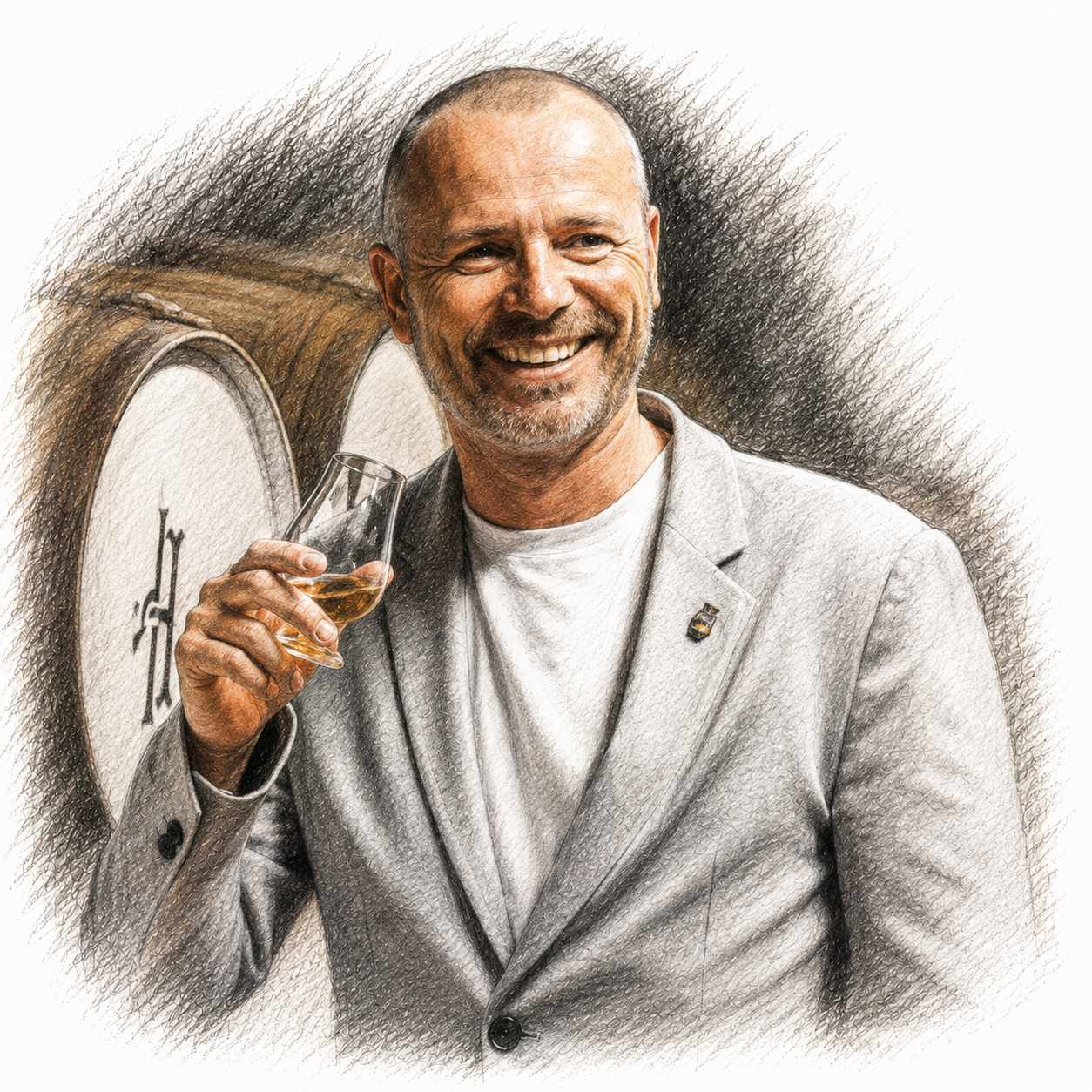
Mitch Bechard has spent the better part of two decades convincing people to fall in love with whisky — first as a Diageo ambassador working golf clubs and global markets, then repping William Grant & Sons brands in the US, and now from his own base in Speyside, where he runs CopperCairn, a bespoke whisky touring company built entirely around the traveller in front of him rather than a fixed itinerary. He’s also co-created Turas Mòr, an independent bottler and whisky adventure brand with his friend Craig Holmes, co-hosts the Not Another Whisky Podcast with fellow whisky ambassador Daryl Haldane, and written a memoir bluntly titled Not Another F@cking Whisky Book, an honest, humorous look behind the scenes of the whisky industry, covering life as an ambassador, marketing, sustainability and some of the wider issues within whisky.
Mitch built the next chapter of his whisky career on the idea that the best whisky moments often happen away from the tasting room — by a river, up a hill, mid-adventure — and it shows in how he judges a distillery: the liquid first, then the people, and only then the marketing. He’s refreshingly honest about the parts of ambassador life the brochures never mention, the day he came home to find a twenty-five-year-old Caol Ila had been turned into a dinner jus, and why he’ll happily send a sceptical guest to a distillery they’ve never heard of and stake the whole trip on it. There’s also a very good story involving a skinny dip in Oban Harbour in January — don’t skip ahead.
The Person
Let’s start at the beginning. What’s the first whisky you can genuinely remember — not necessarily the best one, but the one that made you stop and think, “there’s something interesting here”?
I mean, if I go way back it was Jack Daniel’s and Coke, like a lot of people drank back in the day, but that wasn’t really nuance, it was just having a drink.
I actually write about this in the book — my real first moment was Highland Park. It was a 12 Year Old, and I was in Scotland doing an on-location job interview with a company called Rabbie’s — you’ve probably seen their tour buses if you’ve been to Scotland. I was stopped by a loch and the tour guide pulled out this bottle of Highland Park. My really bad experience up to that point had been downing a quarter bottle of a supermarket’s own-brand whisky on a park bench when I was sixteen, so when he brought that bottle out I had the fear big time — I was absolutely shitting myself, thinking, I don’t want to touch this stuff.
But I was the only Scotsman there, as you can imagine — big international group, Germans, French, some South Africans as well — and they all loved it. The bottle got passed to me and I thought, I’m not going to like this, but being the only Scotsman I’ve got to put on a brave face. I took a big, mighty glug of it, and afterwards I actually went, “I quite enjoyed that — that’s completely different from anything I’ve experienced before.” That’s when I stopped and thought, actually, I need to pay a little more attention to whisky.
“I took a big, mighty plug of it, and afterwards I kind of went, actually, I quite enjoyed that.”
I arrived in Oban that night and my enthusiasm got the better of me. We went to the Oban Bar right on the waterfront — a great little old-school place — and I sat down with the South African guys and the French guys, and we decided a skinny dip in Oban Harbour was a good idea. This is January, about minus four, and I remember seeing snow when I ran into the water. If you’ve been to Oban recently, you’ll know the harbour now — ferries coming in, a load of boat traffic, not the cleanest water in Scotland, let’s put it that way. Long story short, but that was the first time I went, actually, I do like whisky. And there’s something going on here.
Has your own palate changed over the years? Is there a style of whisky you dismissed early on that you’ve since fallen in love with—or one you’ve drifted away from?
One hundred percent. “I read something recently about how much our palate changes over time, and that certainly rings true for me.
When I was with Diageo I was drinking a lot of Lagavulin and Caol Ila, Johnnie Walker — that smoky, peaty side of whisky was always there, and I think my palate got a bit numb to it, to be honest. Then I moved to the US and became the Glenfiddich ambassador, drinking my own brand pretty much 24/7 — as an ambassador you rarely go out of the box and try something else, because you’re on the road so much talking whisky and drinking that brand that when you get home you honestly just want a wine or a beer. It’s hard to do homework on another whisky.
It was about four years into that when I had a Johnnie Walker Black Label and thought, this is so smoky, I don’t remember it being this smoky. That was a real wake-up call, and my palate has become a lot more sensitive to the peat side of things ever since. I was recently on a trip to Islay drinking some incredible whiskies over there, and I still love that big peaty style, but I realised it’s almost too much for my palate now.
Living in Speyside, surrounded by predominantly unpeated whisky, my palate has shifted towards something lighter. I went through a phase of chasing that maritime note you get on the nose — started drinking more manzanilla, fino sherries, pairing them with olives, that salt-on-salt thing, and looking for the same in whisky. Old-style Speyside whiskies like Glen Grant tick a lot of boxes for me now. I never used to like heavily sherried whisky, and now I enjoy a lot more of that style. It’s changing all the time — sorry, that’s a long answer to a short question.
If we opened your home whisky cabinet tonight, what would surprise us?
Quite a few world whiskies. I get gifted them by people I host, from all around the world. I was gifted a Tasmanian whisky recently that’s been flavoured with sheep dung — that’s an interesting one. I’ve got a Norwegian friend who brings me Norwegian whisky constantly. I’ve got a Japanese one that’s been aged in ginger beer casks.
I love sitting down with people and not just talking Scottish whisky, but looking at what’s going on around the world. World whiskies are fascinating right now — they don’t have the shackles we have in Scotch, so they’re doing genuinely interesting things. If people who’ve never tried whisky before realise their own country’s making it too, I think that’s such a positive thing, because for me the old world will always lead back to old-school whisky — and that’ll probably be Scotch. That’s my theory, anyway, and I’m sticking to it.
And it’s not just visitors who get into the good stuff — I came home once to find my wife had used a twenty-five-year-old Caol Ila to make a whisky jus for dinner. Out of all the bottles in the house!
What’s one whisky opinion you hold that most enthusiasts would disagree with?
That’s changed a lot, I think. When I first started talking about whisky it was the old school predominantly drinking it — golf clubs with Diageo, all the old boys telling me they were drinking whisky before I was born, which was always tough. Back then it was very much: you can’t add anything to whisky, you drink it neat, the only thing you add to whisky is more whisky.
I’d like to hope that’s started to change, and I think ambassadors like myself, flying the flag over the last fifteen, twenty years, have helped shift it. I love that, because it’s your whisky — you drink it how you want to. There are aspects of how it’ll change depending on what you do to it, but it’s entirely up to the consumer. I’ve always been very anti the idea that it has to be neat. Put it in the freezer, make it a cocktail, add water, add ice, whatever — I love seeing that attitude change in the world we live in now.
One of the ideas behind Whisky Tasting Fellowship is bringing whisky and people together. You’ve spent years introducing people to Scotland through whisky, and you’ve probably watched hundreds of conversations begin over a shared dram. Was there ever a moment when you realised your job wasn’t really about whisky anymore — it was about creating memories people would still be talking about years later?
I don’t think there’s one exact story, but as an ambassador you start out very much needing to get your knowledge down, get your facts dialled in — there’s a bit of imposter syndrome where you feel like you shouldn’t really be there. So early on it was all about learning everything about whisky.
As I got more comfortable and my knowledge and experience grew, it shifted — I realised I don’t need to be dropping knowledge on fermentation times and the angle of the lyne arm. No one’s really interested in that, it’s the really geeky stuff. It’s more that people buy from people, and it’s about being around someone, opening a nice bottle, and having that conversation. That shift happened for me somewhere between leaving Diageo, joining William Grant & Sons as a Glenfiddich ambassador and later moving to the US — I became the Scottish guy in America telling these stories, and I knew how to bring people into that world a lot more easily. I can’t pinpoint an exact moment, but that’s the timeline of what happens when someone really starts getting into whisky, in my experience.
The Journey — CopperCairn
You could have stayed in brand ambassadorship, or any number of other roles in the industry. Why did you decide that helping people experience Scotland was the path you wanted to take?
It was just before COVID, one of my last big trips with Glenfiddich — I went to Singapore, stayed in unbelievable hotels, big party at Marina Bay by the infinity pool, catamarans, all the really cool stuff. I came back and a friend asked how it was, and I just said, “yeah, it was alright.” Very flippant. After I said it, I took stock of what was going on in my life as an ambassador and thought, why did I say it like that?
I realised I was over the travel, the party, the hardcore side of being an ambassador — but I still loved whisky, still wanted to be an ambassador, just on my own terms. CopperCairn came out of that: I can still be that ambassador, still sleep in my own bed ninety percent of the time, and now I’m an ambassador for the whole whisky industry rather than one brand. I’m based in the heart of Speyside, right in whisky country, and I get to physically show people the inner workings of Scotch whisky rather than just doing it through a tasting.
The travel didn’t wear me out, to be clear — I’m very extroverted, I get my energy from being around people. It was the “away” part. As an ambassador you’re jumping on a plane Monday morning, back Thursday night if you’re lucky, one day to catch up on admin, weekend to reset, and then it happens all over again. Kudos to the ambassadors still doing that all around the world. I do sometimes miss the glamour of it — flying business class, eating out constantly — my liver and my belly are thanking me for stopping, though.
What did you want CopperCairn to be that traditional whisky tours often aren’t?
Going back to Rabbie’s — and I don’t want to badmouth them, they do an amazing job taking people around Scotland and showing them the islands, the glens, the history — I never wanted CopperCairn to be that. I wanted it to be an inside track into the whisky industry. For the geeks we can go down serious rabbit holes; for people who just want to know a little history and see some scenery, we can do that too. Everything’s bespoke.
If someone comes to me and says, I want five days in Scotland, going around distilleries, but I also want to hike a hill and canoe down the River Spey, we’re a one-stop shop for that. That’s what I love — whisky experiences mixed with adventure, mixed with whatever people want in Scotland, whether that’s history, castles, golf, biking, paddleboarding. I’m not a desk guy — if I sit at a desk for more than two days I start losing my mind and my energy drops. Being out and about doing this stuff, and showing people that side of Scotland beyond whisky, is what I love.
What’s the biggest misconception visitors have about Scotland as a whisky destination before they arrive?
That they can just jump around. They look at a map, see two places aren’t far apart, and think they can do it in a day and come back. Scotland’s small on the map, but you’ve got little roads, awkward roads, traffic. I’ve had a lot of conversations where someone wants to go from Speyside to Skye and back in a day — we can do it, but it’ll be a horrendous day of staring at a windscreen. It’s about getting people to chill out a bit and give things more time so it’s actually enjoyable.
Is there a moment during a trip where you can actually see someone’s relationship with whisky change? What usually triggers that?
All the time, and it’s the thing that makes me happiest. Say we’ve got a group of six or seven and two of them only drink wine — I’ll tell them, “you’re my mission for this trip, I’m going to find you a whisky you’ll enjoy,” and nine times out of ten it happens. I keep in touch with a lot of the groups I take around, and I’ll have people who didn’t like Scotch before they met me telling me about what they’re drinking and doing once they’re home. That’s one of the most satisfying things about what I do.
When you’re planning a whisky journey for someone you’ve never met before, where do you start — distilleries, landscapes, or the person first?
Always the person first. Usually over email, ideally a video call, thirty minutes to an hour, working out what they like, what they don’t like, what they want to do. Everything’s bespoke, so it’s about finding what ticks the boxes for them and where they want to go. From there I won’t just take their list — I’ll look at hidden gems they might not know about. We’ve got these little craft and farm distilleries opening up right now — Ballindalloch just down the road, Dunphail up the road — and it’s great taking people somewhere they’d never have found on their own. It’s a mixture of understanding what they like and then delighting them with somewhere new.
Some of the best whisky memories happen away from stills and warehouses. Is there a place, tradition or experience every whisky traveller should have, even if it isn’t directly about whisky?
One of the things I always say is that a whisky depends on your mood and your environment, and I do this a hundred percent of the time: I keep whiskies in the back of the vehicle, everyone gets armed with a Glencairn glass, and we’ll take a moment by the side of a river, or if people are feeling adventurous, up a hill, and have that dram right there. After doing something incredible like a dinner at Macallan or a blending session, a lot of the time people say the moment that really stuck was sitting by the river hearing stories.
“Those whisky-in-the-wild moments really hit with people. Your senses are so much more heightened than if you’re just sitting in a room at a tasting with all these other smells around you.”
That’s definitely one of my favourite things about doing this job.
You’ve hosted visitors from all over the world. Do different nationalities approach Scotch differently, or do they all end up falling in love with it the same way?
We’ve got such history over here, and Scotch is protected enough that you know roughly what you’re getting from the bottle. As for how nationalities react — North Americans in particular hit differently for me, because ninety percent of the time they can trace their history and heritage back to Scotland. There’s a “my great-grandad came from here” connection, so they feel more attached when they arrive. It’s hard to be too stereotypical about it, but there’s definitely more passion from that clientele. And they all go home raving about Scotland — that’s the fun part for me. I’m arguably an ambassador for whisky and an ambassador for Scotland now.
Is there a distillery that consistently surprises people because it isn’t the obvious destination?
GlenAllachie. A lot of people haven’t heard of it, or it’s not available in their market. You get in there and start talking about how independent they are, what Billy Walker’s been doing — a little bit crazy with his experimentation, I don’t think he’d mind me saying. Non-chill filtered, no colour added, predominantly cask strength, a fantastic team up there.
I once had a guest who I knew exactly what he’d like, so I put GlenAllachie on the itinerary as a left-field pick. He kept messaging me for weeks beforehand saying, “Mitch, I don’t think we should do GlenAllachie.” I told him to trust me. He went, loved the tour, loved the tasting, bought a case and a t-shirt.
I think about whisky in three tiers now: first the quality, the taste, the profile. Second, the distillery experience and the people there — because I’m around these guys so often, having a beer with the distillery manager one night. Third, and last, is the marketing. That’s the luxury I have now — I’m at the coalface of these distillery experiences, and it’s changed how I think about brands, because the people and the experience matter more to me than what gets pushed out.
The whisky industry is full of remarkable people whose names never appear on bottles. Who’s someone you’ve met that whisky lovers really should know about?
I was actually hanging out with him this week — Dennis McBain, the coppersmith at Balvenie. He started there at sixteen and he’s still there over fifty years later, still jumping in to help with VIP tours. He recently made me my own copper dog — he asked what year I was born and welded a penny from that year into the bottom of it.
He’s got some unbelievable stories. One of my favourites: the distillery manager once called him and said, “Dennis, grab your anvil and hammer and come with me.” They went into the staff cloakroom, pulled a copper dog out of someone’s jacket pocket, and the manager said, “hammer that flat.” Dennis did, and the manager just put it back in the jacket where he found it — a way of saying, I know what you’re up to, but I’m not going to pull you up on it. Things like that, from back in the day, are gone now as health and safety has quite rightly moved in, but it takes away some of those amazing stories. Guys like Dennis lived through all of it, never expecting anyone would want their stories told, and I find that fascinating.
If you had complete freedom to design the perfect three-day whisky trip for a first-time visitor, what would be non-negotiable?
Haggis, Irn-Bru and whisky, obviously — I’m joking, sort of. What I always say is: one production tour, that’s it. You don’t need to see six or seven distilleries doing the same thing unless you’re really geeky. Ideally one distillery with traditional floor maltings, maybe bottling on site too — hard to find, but we’ve still got a handful in Speyside and a few over on Islay.
One really great whisky experience that’ll stick in the memory — maybe one of those whisky-in-the-wild moments I mentioned. And meeting some of the whisky legends we’ve got kicking around, hearing their stories. We do a lot of whisky dinners and bring in people like Dennis, or Alan Winchester, who’ve lived it for fifty years. Ninety percent of first-timers come away saying they can’t believe they got to meet that person or hear those stories.
I was actually cycling with Alan Winchester down the Speyside Way a couple of days ago — he’s fascinating, I’d say he’s the entire package when it comes to Scotch, his knowledge of distilling and whisky history is second to none. We went past all these distilleries and he was telling me stories I’d never heard, pointing out things from back in the day. For me, that’s it — hanging out with the legends and tapping into those old-school stories.
After years of introducing people to other people’s whiskies, you helped create your own with Turas Mòr. What made you decide it was finally time to put your own ideas into a bottle?
It’s always been a dream, and the opportunity came from a good friend, Craig Holmes. We were having a chat after one of my tastings and he came up to me and said we need to do something with whisky together — he suggested we do a whisky, and that’s where it stemmed from. Turas Mòr came from both our love of adventure and community, bringing people together and putting that into a bottle. Turas Mòr means “great journey.” We’ve done a Mortlach and a Bruichladdich so far, and we’re about to release two Speyside expressions, a Benrinnes and a Dailuaine.
What I love now, because I do so many tastings and pour whisky for so many people, is pulling out a bottle of Turas Mòr and saying, this is mine, see what you think. And then telling them, if you don’t like it, you’re not getting back in the van.
We wanted to embrace a drinker looking for something a bit different — if you look at the packaging, it’s not standard. And it’s not just the bottle: we run whisky adventures too, we actually walk the walk instead of just saying it’s “whisky for the adventurous soul,” which is our tagline. In September we’re taking people on a whisky adventure, having already done one in Speyside.
I’ve got quite a few spinning plates — the whisky, the book, a podcast, CopperCairn — it keeps me off the streets and busy. We’ll see how the whisky goes. I love doing the homework on finding the next cask to bottle, working out what would work for a finish. We might look at building a consistent blend going forward rather than just single casks like we’ve done so far.
Around the same time, you also wrote Not Another F@cking Whisky Book. Did you simply have too many stories not to write down?
That’s exactly it. I kept finishing tastings and tours and people kept telling me I should put it all down on paper, and I kept saying, I’m not an author, I’m not doing that. Then it was Christmas 2023, and I remember writing the first chapter — I’ve got a nice whisky room with a fire going, and it was actually really enjoyable looking back on my past. After that it was whenever the mood took me, writing another chapter or going back over the last one. It took just under two years (released in October 2025) because I never gave myself a deadline.
The title tells you it’s not your standard whisky book — I don’t talk about facts and figures on whisky-making or distilling, I talk about my journey in the Scotch industry as an ambassador. I also ended up covering serious topics within the industry, including women in whisky, sustainability, marketing past and present — that was never the plan when I started, but partway through I realised I needed to write about the industry as well, not just about me. It was a genuinely fun thing to do, and it made me remember things from the past I’d otherwise have forgotten. I’ve been asked if I’ll write another one — probably not, but it was a nice thing to get down on paper.
The Industry
After spending years with whisky travellers, what have they taught you about whisky that surprised you?
Going back to what we talked about earlier — they don’t necessarily want the intricacies of how Scotch is made. They want the stories, the sense of place, the backstage stuff. So many people leave saying they’d never have got that from a book, or from just walking round a facility. I think I knew that when I started CopperCairn, but I didn’t really realise the scale of the appetite for it until I started taking more and more groups out.
Whisky tourism has changed enormously over the past decade. What’s been the biggest positive change?
Whisky tourism officially dates back to 1969, when Glenfiddich became the first Scottish distillery to open to visitors, followed by Glenfarclas. Back then it was: here’s a tour, see how whisky’s made, taste a few, that’s it — I remember when you could even do the Glenfiddich tour for free, tasting included. That’s obviously changed now.
Distilleries setting up today are consciously thinking about whisky tourism from the start — what they’re going to offer and how. Places like Ardbeg have on-site accommodation, and I’d love to see more like it — some distilleries even let you make your own spirit, like Springbank. More places are doing their own blending sessions and warehouse tastings now too, and that’s important, because not everyone wants a standard production tour. If you’ve already seen the fermentation times and the stills once, you don’t need to see it again.
I’d love to see more distilleries do a proper dining experience — Glenturret has two Michelin stars now, Macallan does a six-course tasting lunch and a nine-course tasting dinner, both incredibly high standard. It’s hard, because if you’re running a distillery and making whisky, the food side isn’t necessarily your focus. Some places now offer four-by-four driving, foraging, all sorts. Macallan is a great example of a big brand constantly evolving what it offers, but the smaller craft distilleries doing tours and tastings are doing a great job too. What I love is you can see the big boys producing twenty million litres a year, and distilleries producing twenty thousand, and both sides are thriving.
And what’s something that’s been lost along the way?
Honestly, no — I think tourism in Scotland has just gone from strength to strength. Twenty years ago you’d never have had the breadth of whisky experiences you have now, whether that’s tastings in the cities — Edinburgh’s a great example, you’ve got Holyrood, the Johnnie Walker experience, Port of Leith, all creating brilliant environments. That never existed in the past. You were lucky to get a tour at all, and sometimes you’d just be told to sod off. There are no negatives right now in whisky hospitality and tourism — it’s an amazing job being done by tour guides and visitor centre managers everywhere.
Is there something about Scotch whisky that the industry itself sometimes forgets, but visitors instinctively understand?
Probably the scale of what we’re doing here. We’ve got over 150 single malt distilleries now, and seven big grain distilleries operating too. Visitors realise how much we’re actually making when they arrive — if you work on one brand, you’re often just looking at that brand and not thinking about the bigger picture of what the whole industry is producing.
If every whisky producer in Scotland was listening for just one minute, what’s the one thing you’d want them to hear from the people who visit?
Keep doing what you’re doing. Keep making great whisky, but never forget the people, places and stories that make anyone care about it.
When someone finishes one of your tours and heads home, what do you hope they’re really taking back with them?
A passion for whisky they never had before, an insight into what we do here, and the personalities they’ve met. Scottish people are so friendly, so outgoing, so welcoming — we really want people to enjoy the whisky and enjoy our landscapes. That’s always the feedback, whether it’s me doing the tour or one of the team. We want to show people not just how we make whisky, but our culture — as a nation, I think we’re very welcoming in that regard.
Looking across everything you’ve done — representing brands, guiding people around Scotland, helping create Turas Mòr — what have you learned about why people fall in love with whisky?
That there’s so much to learn about it. From the moment someone tastes it and thinks, “actually, I do like this — screw that whisky that put me off fifteen years ago,” it becomes a rabbit hole they go down. I always say it’s good homework — there’s so much variety in Scotch that I can give someone two whiskies and if they didn’t know better, they’d think they were two completely different spirits, from a heavily peated dram to something really light and delicate.